The Word of God Holistic Wellness Institute
"Helping The World DISCOVER THE WAY of LOVE!"
What criteria should be used to select a thermal imaging monocular?
How is a thermal imaging monocular defined?
A thermal imaging monocular is an optical instrument that enables visualization of an object's thermal characteristics. More precisely, it converts infrared radiation into a visible spectrum perceivable by the human eye.
The primary benefit of a thermal imaging monocular is its ability to measure temperature remotely without requiring placement in the environment or physical contact with the object, allowing temperature assessment across the object's entire surface from a distance.
What monocular to choose?
First, clarify the reason for needing a thermal imager. When selecting a monocular, assess its intended use, size, weight, and integrated features. A monocular enables clear vision during day or night, in low light, rain, and through dense vegetation like tall grass or bushes. Additionally, determine if the device will be weapon-mounted or handheld. After defining the purpose, evaluate the necessary functionalities, as not all available options may be practical for your specific needs.
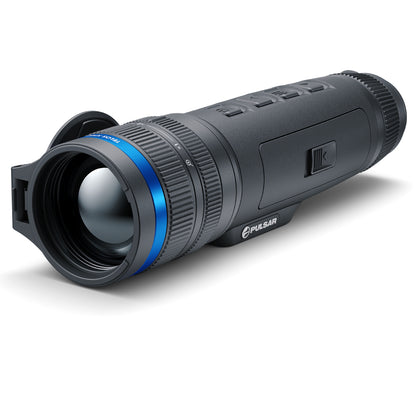
-Device size: Consider the dimensions of the monocular, as its bulkiness may influence its suitability for your intended use. Larger units typically offer enhanced viewing capabilities, while smaller ones provide greater portability. Evaluate whether size is a crucial factor before making your selection.
-Weight: What is the weight of the thermal imager? Most models are lightweight, except for the larger, more powerful monoculars, which tend to be heavier. Users prioritizing advanced functionality may need to accept this added weight. For those who prefer minimal equipment load, compact models are recommended.
-Body material: The construction material of the device's housing influences its durability and resistance to impact damage in the field. Thermal imagers are typically manufactured from metal or plastic, often with a rubber coating to enhance shock absorption.
-Matrix resolution: Pay close attention to the resolution when selecting a thermal imager. Common matrix resolutions are 384×288 or 640×512 pixels; higher resolution results in a sharper and more detailed image.
-Lens diameter: The lens size correlates with viewing distance—the larger the lens, the greater the range. However, a bigger lens reduces the shooter's field of view. For shooting within 100 meters in forested areas, pursuing a large lens is unnecessary. Lenses between 19-35 mm suit short distances, 50 mm lenses are preferable for longer ranges, and if usage is uncertain, consider a PRO model equipped with dual lenses.
-Sensitivity range: NETD measures sensitivity, with a lower NETD indicating higher sensitivity in a thermal imaging monocular.
-Detection range: The specified detection and recognition distances are typically listed in the device's specifications. These ranges are influenced by the optical quality and sensor resolution.
-Battery capacity: A higher battery capacity extends the device’s operating time. Battery life is influenced by incorporated accessories like rangefinders or recorders, as well as extra features such as Wi-Fi.
It is important to highlight that a high-quality thermal imaging monocularimmediately captures the user’s interest. Buyers prioritizing image quality focus on parameters like lens size, focal length, sensitivity, and display resolution. Conversely, users valuing functionality and usability consider internal features such as built-in memory, color palette options, Wi-Fi connectivity, and battery performance equally significant alongside image clarity factors.
Views: 16
Comment
About
Praise Jesus Christ!

May God Bless & Prosper You!
"Holistic Wellness and Health"
Health, Education, and Social Service: Crisis Intervention/Life Empowerment (323) 73-LIGHT
Appointments (323) 402-0422
Loving to Learn Online Store
"Over 300 Low Priced, Quality Products"
Your Holistic Wellness: Spirit, Body and Mind
TIME IS RUNNING OUT!
© 2025 Created by Drs Joshua and Sherilyn Smith.
Powered by


You need to be a member of The Word of God Holistic Wellness Institute to add comments!
Join The Word of God Holistic Wellness Institute